2017 ASH Posters – accordion
by cph-manager | Mar 31, 2017
In March, 2017, we provided posters and information to Ag Educators throughout the Great Plains region to assist with educating agriculture students about health and safety risks and prevention. This page provides additional details for each poster, including recent publications that provide additional information on each poster and ideas on how to incorporate these posters into existing curriculum.
If you click on the poster images below, you will open up the full-scale poster pdf, suitable for printing on 11×17 inch paper.
CONTACT US with Questions or Additional Topics of Interest
FEEDBACK SURVEY: Let us know if these are helpful and recommend additional topics to add.
How Farmers Get Hurt
As you know, there are many ways to get hurt on the farm. While you probably have stories about friends and family who have been injured, we have been looking across the Great Plains region to identify the big picture of farmer injuries.
Data from emergency room records and farmer fatality cases have been used to understand risk factors: How do farmers get hurt?
This poster illustrates key injuries to farmers, using recent fatality data.

A Review of How Midwestern Farmers Get Hurt on the Job
How to Use in Class
- To remind students of injury risks Incorporate into discussions focused on driving safety, material handling, machinery and livestock production
Additional Resources
- Surveillance of Agricultural Injuries and Fatalities web page: http://www.public-health.uiowa.edu/gpcah/center-projects/surveillance-of-agricultural-injuries-and-fatalities/
- Trends in non-fatal agricultural injuries requiring trauma care: https://www.ncbi.nlm.nih.gov/pmc/articles/PMC4669366/
- Characteristics of Fatal Agricultural Injuries by Production Type: https://www.ncbi.nlm.nih.gov/pubmed/27024994
- Surveillance Project, including injury maps and reports: http://www.public-health.uiowa.edu/gpcah/center-projects/surveillance-of-agricultural-injuries-and-fatalities/
- Characteristics of Work- and Non-work-Related Farm Injuries: http://onlinelibrary.wiley.com/doi/10.1111/jrh.12121/full
Tractor-Related Injuries
More Midwest farmers are injured on tractors than by any other hazard on the farm. Tractor rollovers cause 33% of all farmer fatalities, highlighting the importance of using rollover protection. However, we recommend understanding that many other types of non-fatal injuries occur when working on and around tractors.
Data from emergency room records were used to identify leading sources and events associated with how farmers are hurt on tractors. This poster provides information on how Midwest farmers and their families have been hurt when working on and near tractors.

Tractor-Related Injuries
How to Use in Class
- Review when discussing tractor operation and safety
- Incorporate into machine maintenance discussions
Additional Resources
- Characteristics of Farm Equipment-Related Crashes Associated With Injury in Children and Adolescents on Farm Equipment: http://onlinelibrary.wiley.com/doi/10.1111/jrh.12162/abstract
- Lighting and marking policies are associated with reduced farm equipment-related crash rates: a policy analysis of nine Midwestern US states: https://oem.bmj.com/content/73/9/621
- A GIS-based Matched Case-control Study of Road Characteristics in Farm Vehicle Crashes: https://www.ncbi.nlm.nih.gov/pubmed/27468005
- Nonfatal tractor-related injuries presenting to a state trauma system: https://www.ncbi.nlm.nih.gov/pubmed/25934002 or http://www.sciencedirect.com/science/article/pii/S0022437515000146
Tractor Safety: How to Prevent Injuries
To protect farmers, discussions on how to prevent injuries on tractors is needed. The top five types of injuries identified as significant when evaluating databases of fatal and non-fatal injuries are identified. Specific recommendations to prevent falls, collisions, and entanglement in machines are identified. Specific recommendations to both prevent rollovers and to reduce the injuries if a rollover occurs are included.

Injury Prevention Tips for Safe Tractor Operation
How to Use in Class
- Review when discussing tractor operation and safety
- Incorporate into machine maintenance discussions
Additional Resources
- Lighting and marking policies are associated with reduced farm equipment-related crash rates: a policy analysis of nine Midwestern US states: http://oem.bmj.com/content/73/9/62
- Nonfatal tractor-related injuries presenting to a state trauma system: https://www.ncbi.nlm.nih.gov/pubmed/25934002 or http://www.sciencedirect.com/science/article/pii/S0022437515000146
- Example fatality investigation cases to illustrate injury mechanisms:
- Tractor overturn: http://www.public-health.uiowa.edu/face/Reports/PDF-Reports/2005IA015.pdf
- Moving round bales: http://www.public-health.uiowa.edu/face/Reports/PDF-Reports/2005IA013.pdf
- Trapped under combine: http://www.public-health.uiowa.edu/face/Reports/PDF-Reports/2008IA081.pdf
- Riding equipment: http://www.public-health.uiowa.edu/face/Reports/PDF-Reports/2011IA039.pdf
- Overturned: https://www.cdc.gov/niosh/face/stateface/mi/10MI021.html
- Rear-ended by semi: https://www.cdc.gov/niosh/face/stateface/mi/07mi044.html
- Entangled in PTO shaft: http://www.public-health.uiowa.edu/face/Reports/PDF-Reports/Flight%20Elevator%20PTO.pdf
- ASABE Standards:
- Lighting and Marking of Agricultural Equipment on Highways ANSI/ASAE S279.17 Jul 2013
- Roll-Over Protective Structures for Wheeled Agricultural Tractors SAE J1194:1994
- Roll-Over Protective Structures for Compact Utility Tractors ANSI/ASAE S478.1 Feb 2012 R2016
Traffic Safety
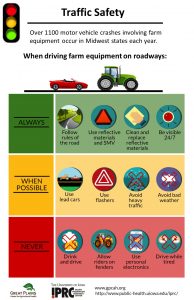
Crashes between farm and public vehicles on roadways pose a serious danger to farmers. This poster is intended to serve as reminders for those driving tractors on roadways but is also useful to have a conversation with other drivers during planting and harvesting seasons.
Roadway Safety Tips
How to Use in Class
- Review when discussing tractor operation and safety
- Review prior to planning and harvesting seasons
Additional Resources
- Lighting and marking study: https://oem.bmj.com/content/73/9/621
- Surveillance of agricultural injuries: http://www.public-health.uiowa.edu/gpcah/center-projects/surveillance-of-agricultural-injuries-and-fatalities/
- Lighting and marking recommendations are summarized in this press release: https://now.uiowa.edu/2016/10/more-stringent-state-policies-lighting-could-reduce-farm-vehicle-traffic-accidents-more-half
- See a round up of media articles on vehicle crashes with tractors: http://www.public-health.uiowa.edu/news-items/ui-study-more-lighting-on-farm-vehicles-would-reduce-number-of-crashes/
Whole Body Vibration
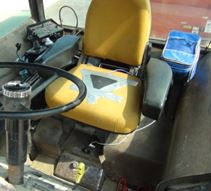
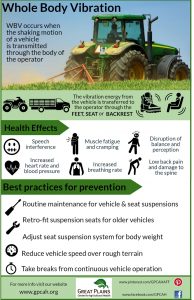
Farmers report musculoskeletal pain, even more so than other industries. Farmers report pain in the back, shoulder, arm, hand, and legs throughout their working years. A significant risk factor to back pain is exposure to whole body vibration (WBV). This poster identifies what WBV is, known health effects, and prevention recommendations. Exposures to WBV can exceed 8-hour recommended limits in as short as 2 hours, depending on the type and age of vehicle being driven. Vibration is lower when pulling a combine, which is heavy and reduces vibration. Farmers operating small vehicles (skid steer loaders) and older vehicles have increased risk of developing back pain. We have also identified that while new tractors have improved vibration control seats, running these at faster speeds may result in the same vibration exposures as running older tractors at slower speeds. How you operate your equipment affects your risk of exposure to WBV and your risk of developing back pain.
What Whole Body Vibration Is and How It Affects Your Health
How to Use in Class
- Discuss how maintaining equipment helps not only good farming but can lead to improved health
- In driving instruction classes, talk about the trade-off of speed and whole body vibration
Additional Resources
- Musculoskeletal pain among Midwest farmers and associations with agricultural activities: https://www.ncbi.nlm.nih.gov/pubmed/25345841
- Information on the study: http://www.public-health.uiowa.edu/gpcah/center-projects/musculoskeletal-symptoms-among-farmers/
Gas Hazards in Agriculture
Hazardous gases are generated as a byproduct of many farming operations. This poster identifies the gas hazards common throughout the region and identifies how these gases are formed. Manure gases have killed livestock producers. Carbon monoxide has killed farmers in grain bins. This poster identifies the hazard and health effects to farmers. This helps interpret ASABE standards on grain bin safety and manure management.

Health Effects and Sources of Important Gas Hazards in Agriculture
How to Use in Class
- In livestock and grain handling courses, discuss these risks as part of the safety discussion.
- Incorporate into any confined space hazard discussions.
- When discussing gas monitoring recommendations by ASABE, use this poster to reinforce what hazards are and were hazards are formed.
Additional Resources
- Manure Gas hazards on GPCAH web site: http://www.public-health.uiowa.edu/gpcah/manure-gases/
- Review fatality investigation reports, such as the following:
- IA Manure Pit Entry: http://www.public-health.uiowa.edu/face/Reports/PDF-Reports/2005IA024-025.pdf
- Pit Entry: https://www.cdc.gov/niosh/face/In-house/full9229.html
- Pit agitation: https://www.cdc.gov/niosh/face/stateface/ia/03ia058.html
- Carbon monoxide: http://www.public-health.uiowa.edu/face/Reports/PDF-Reports/Swine%20Confinement-Final.pdf
- Relevant ASABE standards for manure management:
- Uniform terminology for air quality ANSI/ASABE S588.1, Nov2016
- Manure storage safety ASAE EP470.1 Oct 2011 R2016
- Ventilating manure storages to reduce entry risk ANSI/ASABE S607 Oct2010 R2014
Skin Cancer and You
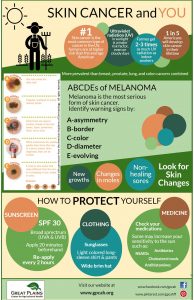
Farmers work outdoors and, by default, are at risk of developing skin cancer from ultraviolet light. Understanding the risk the risk is important to motivate farmers to take simple precautionary actions.
Skin Cancer Recognition and Prevention
How to Use in Class
- Incorporate into discussions on risk management, health care, personal protective equipment.
- Show how to recognize what type of skin changes warrant going to the doctor.
Additional Resources
- General skin cancer risks and information: http://www.skincancer.org/skin-cancer-information/skin-cancer-facts
- Information from the FDA on what medications increase your sensitivity to sun: http://www.fda.gov/Drugs/ResourcesForYou/SpecialFeatures/ucm464195.htm
Hearing Damage: What Do You Have to Lose?
Farm workers suffer from impaired communication, reduced self-esteem, and disrupted intimacy, a result of noise-induced hearing loss. Most also experience tinnitus, a constant ringing or buzzing in the ears. Farm workers are exposed to excessive noise from: tractors, dryers, silage blowers, mowers, livestock, and chain saws, to name a few. Exact numbers are hard to pin down, but studies in 2000 estimate that 72% of farmers have hearing loss. Since hearing loss gradually develops over a working lifetime, early prevention will have great payoffs later in life. This poster explains how future hearing loss may affect common activities. The right side uses disappearing words to visually illustrate how changing of hearing loss affects the ability to communicate as the disease progresses.

Effects of Hearing Loss: What Do You Have to Lose?
How to Use in Class
- When discussing personal protection, risk prevention and management
- Incorporate early in programs when demonstrating loud equipment
- Discuss before internships begin
Additional Resources
- Center information on hearing loss and protection: http://www.public-health.uiowa.edu/gpcah/fact-sheets/hearing-loss/
Hearing Damage: How Loud is Too Loud?
Once the risk of hearing loss is understood, people need to understand when to protect their hearing. When exposed to noise louder than 90 dB, hearing protection is needed. This poster identifies typical sound levels of a variety of equipment and indicates the “Safe Time” that you can be in that noise for a given day. Note that this presumes no noise exposures the rest of the workday. Since this is not likely to happen, protection can help reduce personal exposures to noise. This includes easily available hearing muffs and earplugs.

Interpreting Sound Levels and How Long You Are Safe Without Hearing Protection
How to Use in Class
- When discussing personal protection, risk prevention and management
- Incorporate early in programs when demonstrating loud equipment
- Discuss before internships begin
Additional Resources
- Center information on hearing loss and protection: http://www.public-health.uiowa.edu/gpcah/fact-sheets/hearing-loss/
As you know, there are many ways to get hurt on the farm. While you probably have stories about friends and family who have been injured, we have been looking across the Great Plains region to identify the big picture of farmer injuries.
Data from emergency room records and farmer fatality cases have been used to understand risk factors: How do farmers get hurt?
This poster illustrates key injuries to farmers, using recent fatality data.
A Review of How Midwestern Farmers Get Hurt on the Job
How to Use in Class
- To remind students of injury risks Incorporate into discussions focused on driving safety, material handling, machinery and livestock production
Additional Resources
- Surveillance of Agricultural Injuries and Fatalities web page: http://www.public-health.uiowa.edu/gpcah/center-projects/surveillance-of-agricultural-injuries-and-fatalities/
- Trends in non-fatal agricultural injuries requiring trauma care: https://www.ncbi.nlm.nih.gov/pmc/articles/PMC4669366/
- Characteristics of Fatal Agricultural Injuries by Production Type: https://www.ncbi.nlm.nih.gov/pubmed/27024994
- Surveillance Project, including injury maps and reports: http://www.public-health.uiowa.edu/gpcah/center-projects/surveillance-of-agricultural-injuries-and-fatalities/
- Characteristics of Work- and Non-work-Related Farm Injuries: http://onlinelibrary.wiley.com/doi/10.1111/jrh.12121/full
Tractor-Related Injuries
More Midwest farmers are injured on tractors than by any other hazard on the farm. Tractor rollovers cause 33% of all farmer fatalities, highlighting the importance of using rollover protection. However, we recommend understanding that many other types of non-fatal injuries occur when working on and around tractors.
Data from emergency room records were used to identify leading sources and events associated with how farmers are hurt on tractors. This poster provides information on how Midwest farmers and their families have been hurt when working on and near tractors.
Tractor-Related Injuries
How to Use in Class
- Review when discussing tractor operation and safety
- Incorporate into machine maintenance discussions
Additional Resources
- Characteristics of Farm Equipment-Related Crashes Associated With Injury in Children and Adolescents on Farm Equipment: http://onlinelibrary.wiley.com/doi/10.1111/jrh.12162/abstract
- Lighting and marking policies are associated with reduced farm equipment-related crash rates: a policy analysis of nine Midwestern US states: https://oem.bmj.com/content/73/9/621
- A GIS-based Matched Case-control Study of Road Characteristics in Farm Vehicle Crashes: https://www.ncbi.nlm.nih.gov/pubmed/27468005
- Nonfatal tractor-related injuries presenting to a state trauma system: https://www.ncbi.nlm.nih.gov/pubmed/25934002 or http://www.sciencedirect.com/science/article/pii/S0022437515000146
Tractor Safety: How to Prevent Injuries
To protect farmers, discussions on how to prevent injuries on tractors is needed. The top five types of injuries identified as significant when evaluating databases of fatal and non-fatal injuries are identified. Specific recommendations to prevent falls, collisions, and entanglement in machines are identified. Specific recommendations to both prevent rollovers and to reduce the injuries if a rollover occurs are included.
Injury Prevention Tips for Safe Tractor Operation
How to Use in Class
- Review when discussing tractor operation and safety
- Incorporate into machine maintenance discussions
Additional Resources
- Lighting and marking policies are associated with reduced farm equipment-related crash rates: a policy analysis of nine Midwestern US states: http://oem.bmj.com/content/73/9/62
- Nonfatal tractor-related injuries presenting to a state trauma system: https://www.ncbi.nlm.nih.gov/pubmed/25934002 or http://www.sciencedirect.com/science/article/pii/S0022437515000146
- Example fatality investigation cases to illustrate injury mechanisms:
- Tractor overturn: http://www.public-health.uiowa.edu/face/Reports/PDF-Reports/2005IA015.pdf
- Moving round bales: http://www.public-health.uiowa.edu/face/Reports/PDF-Reports/2005IA013.pdf
- Trapped under combine: http://www.public-health.uiowa.edu/face/Reports/PDF-Reports/2008IA081.pdf
- Riding equipment: http://www.public-health.uiowa.edu/face/Reports/PDF-Reports/2011IA039.pdf
- Overturned: https://www.cdc.gov/niosh/face/stateface/mi/10MI021.html
- Rear-ended by semi: https://www.cdc.gov/niosh/face/stateface/mi/07mi044.html
- Entangled in PTO shaft: http://www.public-health.uiowa.edu/face/Reports/PDF-Reports/Flight%20Elevator%20PTO.pdf
- ASABE Standards:
- Lighting and Marking of Agricultural Equipment on Highways ANSI/ASAE S279.17 Jul 2013
- Roll-Over Protective Structures for Wheeled Agricultural Tractors SAE J1194:1994
- Roll-Over Protective Structures for Compact Utility Tractors ANSI/ASAE S478.1 Feb 2012 R2016
Traffic Safety
Crashes between farm and public vehicles on roadways pose a serious danger to farmers. This poster is intended to serve as reminders for those driving tractors on roadways but is also useful to have a conversation with other drivers during planting and harvesting seasons.
Roadway Safety Tips
How to Use in Class
- Review when discussing tractor operation and safety
- Review prior to planning and harvesting seasons
Additional Resources
- Lighting and marking study: https://oem.bmj.com/content/73/9/621
- Surveillance of agricultural injuries: http://www.public-health.uiowa.edu/gpcah/center-projects/surveillance-of-agricultural-injuries-and-fatalities/
- Lighting and marking recommendations are summarized in this press release: https://now.uiowa.edu/2016/10/more-stringent-state-policies-lighting-could-reduce-farm-vehicle-traffic-accidents-more-half
- See a round up of media articles on vehicle crashes with tractors: http://www.public-health.uiowa.edu/news-items/ui-study-more-lighting-on-farm-vehicles-would-reduce-number-of-crashes/
Whole Body Vibration
Farmers report musculoskeletal pain, even more so than other industries. Farmers report pain in the back, shoulder, arm, hand, and legs throughout their working years. A significant risk factor to back pain is exposure to whole body vibration (WBV). This poster identifies what WBV is, known health effects, and prevention recommendations. Exposures to WBV can exceed 8-hour recommended limits in as short as 2 hours, depending on the type and age of vehicle being driven. Vibration is lower when pulling a combine, which is heavy and reduces vibration. Farmers operating small vehicles (skid steer loaders) and older vehicles have increased risk of developing back pain. We have also identified that while new tractors have improved vibration control seats, running these at faster speeds may result in the same vibration exposures as running older tractors at slower speeds. How you operate your equipment affects your risk of exposure to WBV and your risk of developing back pain.
What Whole Body Vibration Is and How It Affects Your Health
How to Use in Class
- Discuss how maintaining equipment helps not only good farming but can lead to improved health
- In driving instruction classes, talk about the trade-off of speed and whole body vibration
Additional Resources
- Musculoskeletal pain among Midwest farmers and associations with agricultural activities: https://www.ncbi.nlm.nih.gov/pubmed/25345841
- Information on the study: http://www.public-health.uiowa.edu/gpcah/center-projects/musculoskeletal-symptoms-among-farmers/
Gas Hazards in Agriculture
Hazardous gases are generated as a byproduct of many farming operations. This poster identifies the gas hazards common throughout the region and identifies how these gases are formed. Manure gases have killed livestock producers. Carbon monoxide has killed farmers in grain bins. This poster identifies the hazard and health effects to farmers. This helps interpret ASABE standards on grain bin safety and manure management.
Health Effects and Sources of Important Gas Hazards in Agriculture
How to Use in Class
- In livestock and grain handling courses, discuss these risks as part of the safety discussion.
- Incorporate into any confined space hazard discussions.
- When discussing gas monitoring recommendations by ASABE, use this poster to reinforce what hazards are and were hazards are formed.
Additional Resources
- Manure Gas hazards on GPCAH web site: http://www.public-health.uiowa.edu/gpcah/manure-gases/
- Review fatality investigation reports, such as the following:
- IA Manure Pit Entry: http://www.public-health.uiowa.edu/face/Reports/PDF-Reports/2005IA024-025.pdf
- Pit Entry: https://www.cdc.gov/niosh/face/In-house/full9229.html
- Pit agitation: https://www.cdc.gov/niosh/face/stateface/ia/03ia058.html
- Carbon monoxide: http://www.public-health.uiowa.edu/face/Reports/PDF-Reports/Swine%20Confinement-Final.pdf
- Relevant ASABE standards for manure management:
- Uniform terminology for air quality ANSI/ASABE S588.1, Nov2016
- Manure storage safety ASAE EP470.1 Oct 2011 R2016
- Ventilating manure storages to reduce entry risk ANSI/ASABE S607 Oct2010 R2014
Skin Cancer and You
Farmers work outdoors and, by default, are at risk of developing skin cancer from ultraviolet light. Understanding the risk the risk is important to motivate farmers to take simple precautionary actions.
Skin Cancer Recognition and Prevention
How to Use in Class
- Incorporate into discussions on risk management, health care, personal protective equipment.
- Show how to recognize what type of skin changes warrant going to the doctor.
Additional Resources
- General skin cancer risks and information: http://www.skincancer.org/skin-cancer-information/skin-cancer-facts
- Information from the FDA on what medications increase your sensitivity to sun: http://www.fda.gov/Drugs/ResourcesForYou/SpecialFeatures/ucm464195.htm
Hearing Damage: What Do You Have to Lose?
Farm workers suffer from impaired communication, reduced self-esteem, and disrupted intimacy, a result of noise-induced hearing loss. Most also experience tinnitus, a constant ringing or buzzing in the ears. Farm workers are exposed to excessive noise from: tractors, dryers, silage blowers, mowers, livestock, and chain saws, to name a few. Exact numbers are hard to pin down, but studies in 2000 estimate that 72% of farmers have hearing loss. Since hearing loss gradually develops over a working lifetime, early prevention will have great payoffs later in life. This poster explains how future hearing loss may affect common activities. The right side uses disappearing words to visually illustrate how changing of hearing loss affects the ability to communicate as the disease progresses.
Effects of Hearing Loss: What Do You Have to Lose?
How to Use in Class
- When discussing personal protection, risk prevention and management
- Incorporate early in programs when demonstrating loud equipment
- Discuss before internships begin
Additional Resources
- Center information on hearing loss and protection: http://www.public-health.uiowa.edu/gpcah/fact-sheets/hearing-loss/
Hearing Damage: How Loud is Too Loud?
Once the risk of hearing loss is understood, people need to understand when to protect their hearing. When exposed to noise louder than 90 dB, hearing protection is needed. This poster identifies typical sound levels of a variety of equipment and indicates the “Safe Time” that you can be in that noise for a given day. Note that this presumes no noise exposures the rest of the workday. Since this is not likely to happen, protection can help reduce personal exposures to noise. This includes easily available hearing muffs and earplugs.
Interpreting Sound Levels and How Long You Are Safe Without Hearing Protection
How to Use in Class
- When discussing personal protection, risk prevention and management
- Incorporate early in programs when demonstrating loud equipment
- Discuss before internships begin
Additional Resources
- Center information on hearing loss and protection: http://www.public-health.uiowa.edu/gpcah/fact-sheets/hearing-loss/
To protect farmers, discussions on how to prevent injuries on tractors is needed. The top five types of injuries identified as significant when evaluating databases of fatal and non-fatal injuries are identified. Specific recommendations to prevent falls, collisions, and entanglement in machines are identified. Specific recommendations to both prevent rollovers and to reduce the injuries if a rollover occurs are included.
Injury Prevention Tips for Safe Tractor Operation
How to Use in Class
- Review when discussing tractor operation and safety
- Incorporate into machine maintenance discussions
Additional Resources
- Lighting and marking policies are associated with reduced farm equipment-related crash rates: a policy analysis of nine Midwestern US states: http://oem.bmj.com/content/73/9/62
- Nonfatal tractor-related injuries presenting to a state trauma system: https://www.ncbi.nlm.nih.gov/pubmed/25934002 or http://www.sciencedirect.com/science/article/pii/S0022437515000146
- Example fatality investigation cases to illustrate injury mechanisms:
- Tractor overturn: http://www.public-health.uiowa.edu/face/Reports/PDF-Reports/2005IA015.pdf
- Moving round bales: http://www.public-health.uiowa.edu/face/Reports/PDF-Reports/2005IA013.pdf
- Trapped under combine: http://www.public-health.uiowa.edu/face/Reports/PDF-Reports/2008IA081.pdf
- Riding equipment: http://www.public-health.uiowa.edu/face/Reports/PDF-Reports/2011IA039.pdf
- Overturned: https://www.cdc.gov/niosh/face/stateface/mi/10MI021.html
- Rear-ended by semi: https://www.cdc.gov/niosh/face/stateface/mi/07mi044.html
- Entangled in PTO shaft: http://www.public-health.uiowa.edu/face/Reports/PDF-Reports/Flight%20Elevator%20PTO.pdf
- ASABE Standards:
- Lighting and Marking of Agricultural Equipment on Highways ANSI/ASAE S279.17 Jul 2013
- Roll-Over Protective Structures for Wheeled Agricultural Tractors SAE J1194:1994
- Roll-Over Protective Structures for Compact Utility Tractors ANSI/ASAE S478.1 Feb 2012 R2016
Traffic Safety
Crashes between farm and public vehicles on roadways pose a serious danger to farmers. This poster is intended to serve as reminders for those driving tractors on roadways but is also useful to have a conversation with other drivers during planting and harvesting seasons.
Roadway Safety Tips
How to Use in Class
- Review when discussing tractor operation and safety
- Review prior to planning and harvesting seasons
Additional Resources
- Lighting and marking study: https://oem.bmj.com/content/73/9/621
- Surveillance of agricultural injuries: http://www.public-health.uiowa.edu/gpcah/center-projects/surveillance-of-agricultural-injuries-and-fatalities/
- Lighting and marking recommendations are summarized in this press release: https://now.uiowa.edu/2016/10/more-stringent-state-policies-lighting-could-reduce-farm-vehicle-traffic-accidents-more-half
- See a round up of media articles on vehicle crashes with tractors: http://www.public-health.uiowa.edu/news-items/ui-study-more-lighting-on-farm-vehicles-would-reduce-number-of-crashes/
Whole Body Vibration
Farmers report musculoskeletal pain, even more so than other industries. Farmers report pain in the back, shoulder, arm, hand, and legs throughout their working years. A significant risk factor to back pain is exposure to whole body vibration (WBV). This poster identifies what WBV is, known health effects, and prevention recommendations. Exposures to WBV can exceed 8-hour recommended limits in as short as 2 hours, depending on the type and age of vehicle being driven. Vibration is lower when pulling a combine, which is heavy and reduces vibration. Farmers operating small vehicles (skid steer loaders) and older vehicles have increased risk of developing back pain. We have also identified that while new tractors have improved vibration control seats, running these at faster speeds may result in the same vibration exposures as running older tractors at slower speeds. How you operate your equipment affects your risk of exposure to WBV and your risk of developing back pain.
What Whole Body Vibration Is and How It Affects Your Health
How to Use in Class
- Discuss how maintaining equipment helps not only good farming but can lead to improved health
- In driving instruction classes, talk about the trade-off of speed and whole body vibration
Additional Resources
- Musculoskeletal pain among Midwest farmers and associations with agricultural activities: https://www.ncbi.nlm.nih.gov/pubmed/25345841
- Information on the study: http://www.public-health.uiowa.edu/gpcah/center-projects/musculoskeletal-symptoms-among-farmers/
Gas Hazards in Agriculture
Hazardous gases are generated as a byproduct of many farming operations. This poster identifies the gas hazards common throughout the region and identifies how these gases are formed. Manure gases have killed livestock producers. Carbon monoxide has killed farmers in grain bins. This poster identifies the hazard and health effects to farmers. This helps interpret ASABE standards on grain bin safety and manure management.
Health Effects and Sources of Important Gas Hazards in Agriculture
How to Use in Class
- In livestock and grain handling courses, discuss these risks as part of the safety discussion.
- Incorporate into any confined space hazard discussions.
- When discussing gas monitoring recommendations by ASABE, use this poster to reinforce what hazards are and were hazards are formed.
Additional Resources
- Manure Gas hazards on GPCAH web site: http://www.public-health.uiowa.edu/gpcah/manure-gases/
- Review fatality investigation reports, such as the following:
- IA Manure Pit Entry: http://www.public-health.uiowa.edu/face/Reports/PDF-Reports/2005IA024-025.pdf
- Pit Entry: https://www.cdc.gov/niosh/face/In-house/full9229.html
- Pit agitation: https://www.cdc.gov/niosh/face/stateface/ia/03ia058.html
- Carbon monoxide: http://www.public-health.uiowa.edu/face/Reports/PDF-Reports/Swine%20Confinement-Final.pdf
- Relevant ASABE standards for manure management:
- Uniform terminology for air quality ANSI/ASABE S588.1, Nov2016
- Manure storage safety ASAE EP470.1 Oct 2011 R2016
- Ventilating manure storages to reduce entry risk ANSI/ASABE S607 Oct2010 R2014
Skin Cancer and You
Farmers work outdoors and, by default, are at risk of developing skin cancer from ultraviolet light. Understanding the risk the risk is important to motivate farmers to take simple precautionary actions.
Skin Cancer Recognition and Prevention
How to Use in Class
- Incorporate into discussions on risk management, health care, personal protective equipment.
- Show how to recognize what type of skin changes warrant going to the doctor.
Additional Resources
- General skin cancer risks and information: http://www.skincancer.org/skin-cancer-information/skin-cancer-facts
- Information from the FDA on what medications increase your sensitivity to sun: http://www.fda.gov/Drugs/ResourcesForYou/SpecialFeatures/ucm464195.htm
Hearing Damage: What Do You Have to Lose?
Farm workers suffer from impaired communication, reduced self-esteem, and disrupted intimacy, a result of noise-induced hearing loss. Most also experience tinnitus, a constant ringing or buzzing in the ears. Farm workers are exposed to excessive noise from: tractors, dryers, silage blowers, mowers, livestock, and chain saws, to name a few. Exact numbers are hard to pin down, but studies in 2000 estimate that 72% of farmers have hearing loss. Since hearing loss gradually develops over a working lifetime, early prevention will have great payoffs later in life. This poster explains how future hearing loss may affect common activities. The right side uses disappearing words to visually illustrate how changing of hearing loss affects the ability to communicate as the disease progresses.
Effects of Hearing Loss: What Do You Have to Lose?
How to Use in Class
- When discussing personal protection, risk prevention and management
- Incorporate early in programs when demonstrating loud equipment
- Discuss before internships begin
Additional Resources
- Center information on hearing loss and protection: http://www.public-health.uiowa.edu/gpcah/fact-sheets/hearing-loss/
Hearing Damage: How Loud is Too Loud?
Once the risk of hearing loss is understood, people need to understand when to protect their hearing. When exposed to noise louder than 90 dB, hearing protection is needed. This poster identifies typical sound levels of a variety of equipment and indicates the “Safe Time” that you can be in that noise for a given day. Note that this presumes no noise exposures the rest of the workday. Since this is not likely to happen, protection can help reduce personal exposures to noise. This includes easily available hearing muffs and earplugs.
Interpreting Sound Levels and How Long You Are Safe Without Hearing Protection
How to Use in Class
- When discussing personal protection, risk prevention and management
- Incorporate early in programs when demonstrating loud equipment
- Discuss before internships begin
Additional Resources
- Center information on hearing loss and protection: http://www.public-health.uiowa.edu/gpcah/fact-sheets/hearing-loss/
Farmers report musculoskeletal pain, even more so than other industries. Farmers report pain in the back, shoulder, arm, hand, and legs throughout their working years. A significant risk factor to back pain is exposure to whole body vibration (WBV). This poster identifies what WBV is, known health effects, and prevention recommendations. Exposures to WBV can exceed 8-hour recommended limits in as short as 2 hours, depending on the type and age of vehicle being driven. Vibration is lower when pulling a combine, which is heavy and reduces vibration. Farmers operating small vehicles (skid steer loaders) and older vehicles have increased risk of developing back pain. We have also identified that while new tractors have improved vibration control seats, running these at faster speeds may result in the same vibration exposures as running older tractors at slower speeds. How you operate your equipment affects your risk of exposure to WBV and your risk of developing back pain.
What Whole Body Vibration Is and How It Affects Your Health
How to Use in Class
- Discuss how maintaining equipment helps not only good farming but can lead to improved health
- In driving instruction classes, talk about the trade-off of speed and whole body vibration
Additional Resources
- Musculoskeletal pain among Midwest farmers and associations with agricultural activities: https://www.ncbi.nlm.nih.gov/pubmed/25345841
- Information on the study: http://www.public-health.uiowa.edu/gpcah/center-projects/musculoskeletal-symptoms-among-farmers/
Gas Hazards in Agriculture
Hazardous gases are generated as a byproduct of many farming operations. This poster identifies the gas hazards common throughout the region and identifies how these gases are formed. Manure gases have killed livestock producers. Carbon monoxide has killed farmers in grain bins. This poster identifies the hazard and health effects to farmers. This helps interpret ASABE standards on grain bin safety and manure management.
Health Effects and Sources of Important Gas Hazards in Agriculture
How to Use in Class
- In livestock and grain handling courses, discuss these risks as part of the safety discussion.
- Incorporate into any confined space hazard discussions.
- When discussing gas monitoring recommendations by ASABE, use this poster to reinforce what hazards are and were hazards are formed.
Additional Resources
- Manure Gas hazards on GPCAH web site: http://www.public-health.uiowa.edu/gpcah/manure-gases/
- Review fatality investigation reports, such as the following:
- IA Manure Pit Entry: http://www.public-health.uiowa.edu/face/Reports/PDF-Reports/2005IA024-025.pdf
- Pit Entry: https://www.cdc.gov/niosh/face/In-house/full9229.html
- Pit agitation: https://www.cdc.gov/niosh/face/stateface/ia/03ia058.html
- Carbon monoxide: http://www.public-health.uiowa.edu/face/Reports/PDF-Reports/Swine%20Confinement-Final.pdf
- Relevant ASABE standards for manure management:
- Uniform terminology for air quality ANSI/ASABE S588.1, Nov2016
- Manure storage safety ASAE EP470.1 Oct 2011 R2016
- Ventilating manure storages to reduce entry risk ANSI/ASABE S607 Oct2010 R2014
Skin Cancer and You
Farmers work outdoors and, by default, are at risk of developing skin cancer from ultraviolet light. Understanding the risk the risk is important to motivate farmers to take simple precautionary actions.
Skin Cancer Recognition and Prevention
How to Use in Class
- Incorporate into discussions on risk management, health care, personal protective equipment.
- Show how to recognize what type of skin changes warrant going to the doctor.
Additional Resources
- General skin cancer risks and information: http://www.skincancer.org/skin-cancer-information/skin-cancer-facts
- Information from the FDA on what medications increase your sensitivity to sun: http://www.fda.gov/Drugs/ResourcesForYou/SpecialFeatures/ucm464195.htm
Hearing Damage: What Do You Have to Lose?
Farm workers suffer from impaired communication, reduced self-esteem, and disrupted intimacy, a result of noise-induced hearing loss. Most also experience tinnitus, a constant ringing or buzzing in the ears. Farm workers are exposed to excessive noise from: tractors, dryers, silage blowers, mowers, livestock, and chain saws, to name a few. Exact numbers are hard to pin down, but studies in 2000 estimate that 72% of farmers have hearing loss. Since hearing loss gradually develops over a working lifetime, early prevention will have great payoffs later in life. This poster explains how future hearing loss may affect common activities. The right side uses disappearing words to visually illustrate how changing of hearing loss affects the ability to communicate as the disease progresses.
Effects of Hearing Loss: What Do You Have to Lose?
How to Use in Class
- When discussing personal protection, risk prevention and management
- Incorporate early in programs when demonstrating loud equipment
- Discuss before internships begin
Additional Resources
- Center information on hearing loss and protection: http://www.public-health.uiowa.edu/gpcah/fact-sheets/hearing-loss/
Hearing Damage: How Loud is Too Loud?
Once the risk of hearing loss is understood, people need to understand when to protect their hearing. When exposed to noise louder than 90 dB, hearing protection is needed. This poster identifies typical sound levels of a variety of equipment and indicates the “Safe Time” that you can be in that noise for a given day. Note that this presumes no noise exposures the rest of the workday. Since this is not likely to happen, protection can help reduce personal exposures to noise. This includes easily available hearing muffs and earplugs.
Interpreting Sound Levels and How Long You Are Safe Without Hearing Protection
How to Use in Class
- When discussing personal protection, risk prevention and management
- Incorporate early in programs when demonstrating loud equipment
- Discuss before internships begin
Additional Resources
- Center information on hearing loss and protection: http://www.public-health.uiowa.edu/gpcah/fact-sheets/hearing-loss/
Farmers work outdoors and, by default, are at risk of developing skin cancer from ultraviolet light. Understanding the risk the risk is important to motivate farmers to take simple precautionary actions.
Skin Cancer Recognition and Prevention
How to Use in Class
- Incorporate into discussions on risk management, health care, personal protective equipment.
- Show how to recognize what type of skin changes warrant going to the doctor.
Additional Resources
- General skin cancer risks and information: http://www.skincancer.org/skin-cancer-information/skin-cancer-facts
- Information from the FDA on what medications increase your sensitivity to sun: http://www.fda.gov/Drugs/ResourcesForYou/SpecialFeatures/ucm464195.htm
Hearing Damage: What Do You Have to Lose?
Farm workers suffer from impaired communication, reduced self-esteem, and disrupted intimacy, a result of noise-induced hearing loss. Most also experience tinnitus, a constant ringing or buzzing in the ears. Farm workers are exposed to excessive noise from: tractors, dryers, silage blowers, mowers, livestock, and chain saws, to name a few. Exact numbers are hard to pin down, but studies in 2000 estimate that 72% of farmers have hearing loss. Since hearing loss gradually develops over a working lifetime, early prevention will have great payoffs later in life. This poster explains how future hearing loss may affect common activities. The right side uses disappearing words to visually illustrate how changing of hearing loss affects the ability to communicate as the disease progresses.
Effects of Hearing Loss: What Do You Have to Lose?
How to Use in Class
- When discussing personal protection, risk prevention and management
- Incorporate early in programs when demonstrating loud equipment
- Discuss before internships begin
Additional Resources
- Center information on hearing loss and protection: http://www.public-health.uiowa.edu/gpcah/fact-sheets/hearing-loss/
Hearing Damage: How Loud is Too Loud?
Once the risk of hearing loss is understood, people need to understand when to protect their hearing. When exposed to noise louder than 90 dB, hearing protection is needed. This poster identifies typical sound levels of a variety of equipment and indicates the “Safe Time” that you can be in that noise for a given day. Note that this presumes no noise exposures the rest of the workday. Since this is not likely to happen, protection can help reduce personal exposures to noise. This includes easily available hearing muffs and earplugs.
Interpreting Sound Levels and How Long You Are Safe Without Hearing Protection
How to Use in Class
- When discussing personal protection, risk prevention and management
- Incorporate early in programs when demonstrating loud equipment
- Discuss before internships begin
Additional Resources
- Center information on hearing loss and protection: http://www.public-health.uiowa.edu/gpcah/fact-sheets/hearing-loss/
Once the risk of hearing loss is understood, people need to understand when to protect their hearing. When exposed to noise louder than 90 dB, hearing protection is needed. This poster identifies typical sound levels of a variety of equipment and indicates the “Safe Time” that you can be in that noise for a given day. Note that this presumes no noise exposures the rest of the workday. Since this is not likely to happen, protection can help reduce personal exposures to noise. This includes easily available hearing muffs and earplugs.
Interpreting Sound Levels and How Long You Are Safe Without Hearing Protection
How to Use in Class
- When discussing personal protection, risk prevention and management
- Incorporate early in programs when demonstrating loud equipment
- Discuss before internships begin
Additional Resources
- Center information on hearing loss and protection: http://www.public-health.uiowa.edu/gpcah/fact-sheets/hearing-loss/